5 Free Web Tools I Built as a Solo Developer
Over the past year, I have built and shipped multiple free web tools as a solo developer from Pakistan. No team, no investors, no marketing budget. Just me, my laptop, and a lot of late nights. Some of these tools took off faster than I expected. Others taught me hard lessons about what users actually want versus what I thought they needed. Here is the honest story behind five of my most impactful projects, with real numbers and real takeaways.
1. MZift UTM Builder — A Full UTM Platform
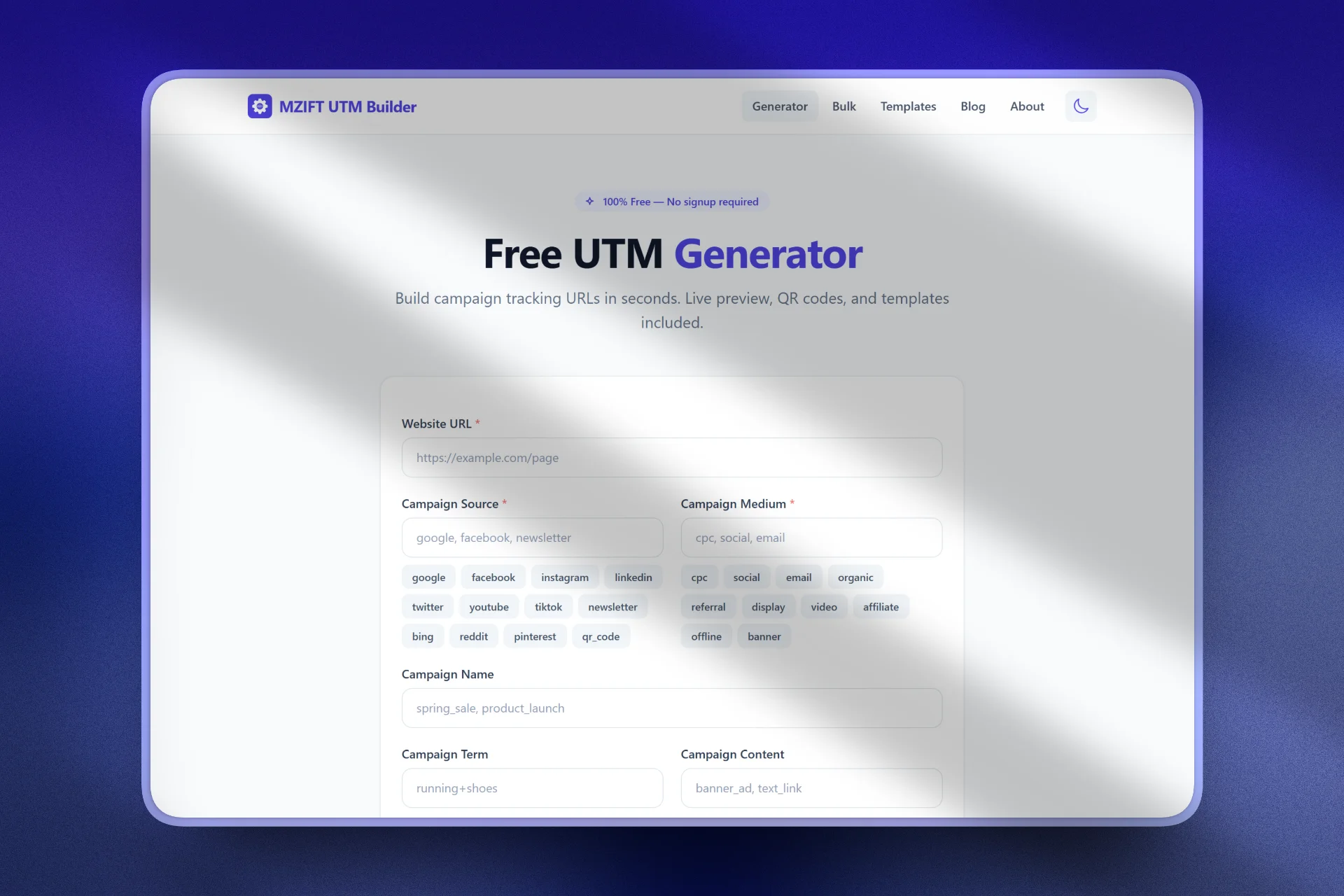
The UTM Builder started because I was tired of manually typing UTM parameters into URLs. Google's Campaign URL Builder felt outdated, and every alternative I tried either required a signup or was cluttered with ads. So I built my own, and then kept building.
What started as a simple generator became a full UTM platform. The core tool lets you build campaign URLs with live preview, but I added a Bulk Generator that processes up to 100 URLs via CSV upload, over 30 quick templates for every major platform from Facebook Ads to TikTok to QR Code/Print, and downloadable SVG QR codes for any UTM link. Your last 20 generated links are saved in the browser, and you can create your own custom reusable templates.
Then I built nine dedicated platform generators: TikTok, LinkedIn, Facebook, Google Ads, HubSpot, Webflow, Chargify, Tilda, and Keap. Each comes pre-configured with the correct source and medium values and platform-specific features like TikTok dynamic macros. On top of that, I wrote a full blog with in-depth guides on UTM parameters, best practices, GA4 setup, and platform-specific tutorials. The tool hit 600+ visitors in its first month, driven almost entirely by organic search from that content layer.
2. Holy Quran Reader — 1,500+ Visitors in Three Months
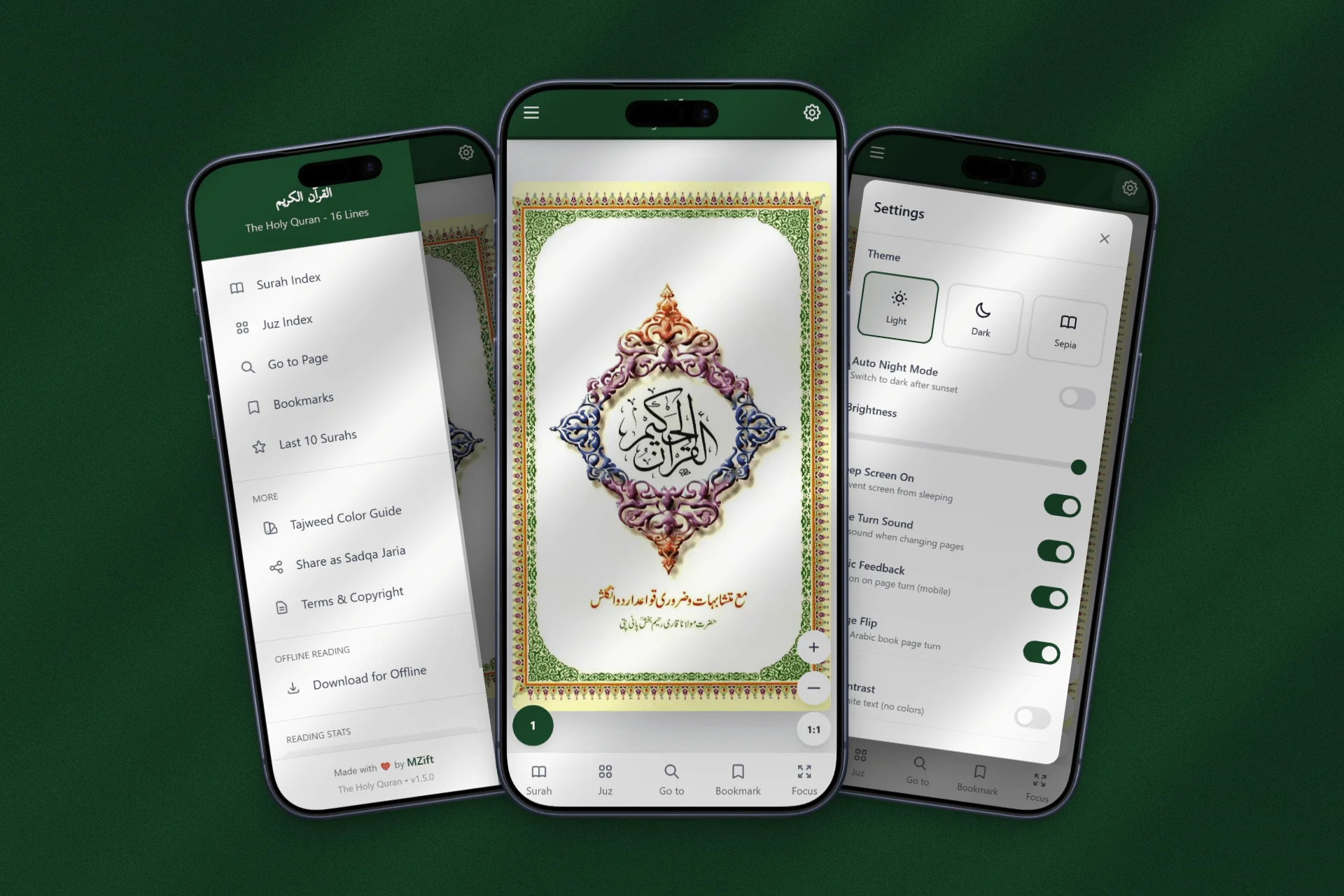
This project is close to my heart. I wanted to build a Quran reader that was clean, respectful, and distraction-free. Most existing Quran apps are overloaded with features or filled with ads that feel inappropriate next to sacred text. My goal was simple: let people read the Quran with proper color-coded Tajweed in a beautiful layout.
The reader features an authentic 16-line Mushaf layout with color-coded Tajweed rules and a built-in Tajweed guide. It has a 3D page flip animation for a natural reading feel, touch and swipe gestures, bookmarks with reading progress tracking, Surah and Juz index navigation, auto night mode with multiple themes, and full offline support as a Progressive Web App. It is now at version 1.5.0 and works on iOS, Android, Windows, Mac, and Linux.
I released it under what I call a Sadqa Jariya License: the app must remain 100% free and ad-free forever. You cannot sell it, add advertisements, ask for donations, or earn money from it in any way. The Word of Allah should never be monetized. Quran page images are sourced from GuidancetoQuran.com, and I link to Quran.com and Sunnah.com as additional resources.
Within three months, the reader attracted over 1,500 visitors. Users consistently praise the clean interface and accurate Tajweed coloring. It taught me that sometimes the best feature is what you leave out.
3. Digital Tasbeeh — Worship Without Distractions
The Digital Tasbeeh grew out of the Quran reader. Users who visited the Quran reader were also looking for a simple dhikr counter, and the existing options were disappointing. Most digital tasbeeh apps track your data, show ads during worship, or require unnecessary permissions.
I built a clean, ad-free tasbeeh counter with a library of authentic duas and dhikr sourced from the Quran and authentic hadith collections: Bukhari, Muslim, Abu Dawud, Tirmidhi, and Nasa'i. Every phrase includes Arabic text, transliteration, English translation, and the specific hadith reference. The counter supports preset targets of 33, 99, and 100, plus custom counts, with optional sound and haptic feedback.
The quick start section gives you the most common post-salah dhikr right away: SubhanAllah 33 times, Alhamdulillah 33 times, Allahu Akbar 34 times, and La ilaha illallah with its full declaration 100 times. Like the Quran reader, it is a Sadqa Jariya project: free forever, ad-free forever, no accounts, no sign-ups, no analytics tracking your worship. It works completely offline after the first visit.
4. Hijri Calendar — 300+ Visitors in Week One
Finding accurate Hijri dates online usually means wading through ad-heavy websites with poor user experience. I wanted a clean, fast Islamic calendar that showed Hijri and Gregorian dates side by side with real utility.
The Hijri Calendar includes a bidirectional date converter for instant Hijri-to-Gregorian and Gregorian-to-Hijri conversions. The events page lists all major Islamic occasions with live countdowns showing days, hours, minutes, and seconds until events like Eid al-Adha, Day of Arafah, and Islamic New Year. A comprehensive months section provides historical and religious context for each Hijri month. It also has calendar export so users can add Islamic dates to their favorite calendar app and social sharing built in.
The calendar uses the Umm al-Qura calendar system for accuracy, with a clear disclaimer that actual dates may differ by one to two days based on local moon sighting. Like my other Islamic tools, it is a Sadqa Jariya project: completely free, ad-free, and built for the Ummah. It attracted over 300 visitors in its first week through organic search.
5. MZift Web Tools — 71 Tools and Growing
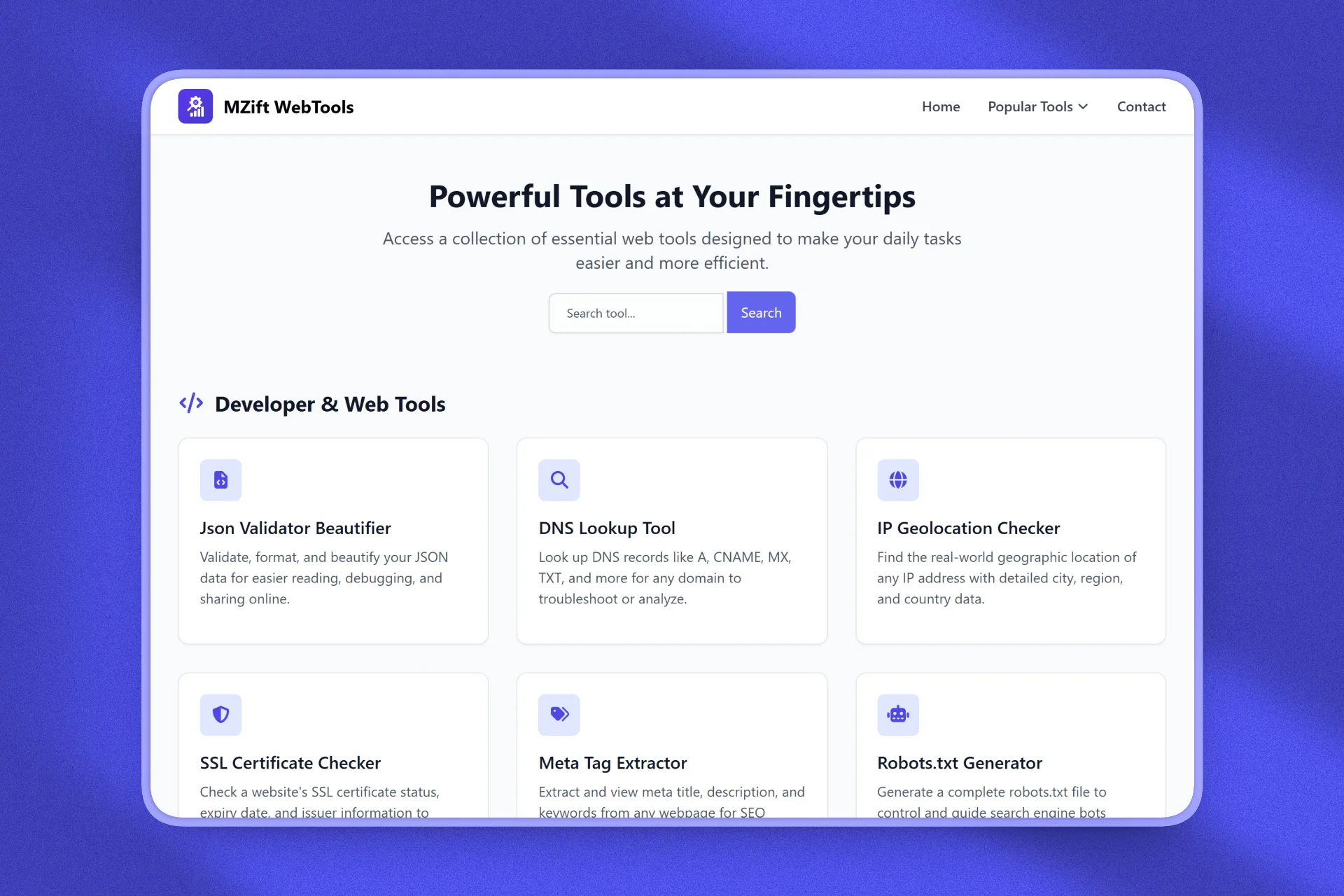
MZift Web Tools is the largest project in the collection. It is a suite of 71 free online tools organized across seven categories: Text Tools, Calculators, Dev Tools, Converters, Generators, Media Tools, and Image Tools.
The Text Tools include a word and character counter, typing speed test, case converter, text-to-speech, and an Instagram font generator. The Calculators section has 16 tools ranging from a BMI calculator and mortgage payoff calculator to a snow day predictor, stair stringer calculator, and even a Starbucks calorie calculator. Dev Tools cover JSON validation and beautification, DNS lookup, SSL certificate checking, meta tag extraction, robots.txt and sitemap generators, password generation, binary-to-text conversion, and a directory tree generator.
The Converters handle military time, Unix timestamps, unit conversion across length, weight, temperature, volume and more, a color picker with HEX, RGB, HSL, and CMYK support, and a time zone converter. The Generators include random numbers, fake addresses for testing, and a random country picker. Media Tools offer a YouTube thumbnail downloader and IP geolocation checker. And the Image Tools section is the biggest with 31 tools covering every image format conversion you can think of: PNG, JPG, WEBP, BMP, ICO, and GIF, in every direction, plus an image optimizer.
Every tool runs client-side for privacy, loads fast with no bloat, works on mobile, and requires no sign-up. The entire suite is free forever with no paywalls, no premium tiers, and no hidden limits. It serves over 300 users monthly and continues to grow as I add new tools.
The Common Thread
Looking at all five projects, the pattern is clear. Every tool that succeeded was built to solve a problem I personally experienced. The tech stack stayed consistent: PHP, Tailwind CSS, and vanilla JavaScript. No frameworks, no build tools, no complexity for the sake of complexity. This consistency meant I could ship faster and maintain everything without losing my mind.
The Islamic tools share a deeper common thread: the Sadqa Jariya principle. The Quran reader, Tasbeeh, and Hijri Calendar are all free and ad-free forever because I believe tools for worship should never be monetized. This is not just a business decision. It is a personal conviction.
What I Learned
First, content is distribution. Every tool that grew had a content layer around it. The tools themselves do not rank in search. The content around them does, and it brings users to the tool.
Second, free does not mean low quality. Seventy-one tools, all free, all functional, all maintained. That has built trust and organic growth that no marketing budget could replicate.
Third, ship small and iterate. None of these tools launched with every feature. The Quran reader is now on version 1.5.0. The UTM builder has added nine platform generators since launch. They started minimal and grew based on real user needs.
Fourth, respect your users' context. A Quran reader is not a news app. A tasbeeh counter is not a fitness tracker. Understanding the context in which people use your tool should inform every design and technical decision.
If you want to try any of these tools, visit mzift.com for links to everything. And if you are a fellow indie maker, my advice is simple: solve your own problems first, ship fast, and let the users tell you what to build next.